Stuck on an SQE1 Practice Question? Take a Hint Before You Answer
How Solon hints work in our question bank, as at 11 November 2026
The short answer
- You can ask for a hint before you answer. On untimed SQE1 practice questions in our question bank, Solon gives up to three hints, one per tap of the Hint button.
- Each hint does one job. Hint 1 asks what the question is really about. Hint 2 points at the legal test and the fact that matters. Hint 3 strikes out three wrong options and leaves two.
- Solon never gives the answer. You make the final choice. A right answer is marked "Correct, with a hint", and the question comes back later so you can try it without help.
- Hints are for learning, not for timing. There are no hints in timed sets or mock sessions, because there are none in the exam.
Why a hint is better than reading the explanation
When you are stuck on an SQE1 practice question, you usually do one of two things. You guess, or you give up and read the explanation.
Neither helps much. A guess teaches you nothing, even when it lands. The explanation hands you the rule and the answer together, so you never practise the step you were missing. It all looks obvious on the page, and the same gap is still there a week later.
SQE1 questions ask for the single best answer from five options. In our experience, candidates get stuck at one of three points:
- The issue. You can't tell which area of law the facts are testing.
- The test. You know the area, but not which rule applies or which fact decides it.
- The last two. You have ruled out three options and can't separate the two that remain.
The three hints match those three points. You take only as much help as you need, and you still do the last step yourself.
How the three hints work
Hints appear in a card between the question and the options. The card shows the latest hint and how many you have used. Earlier hints stay available under "Earlier hints".
Hint 1: what is the question really about?
The first hint asks you a question back. It names the issue the facts raise without saying how it comes out. For many questions, that is enough: once you know what is being tested, the rule comes back to you.
Hint 2: which test, and which fact?
The second hint points at the legal test to apply and the fact in the question that matters most. It doesn't apply the test for you or state the result.
Hint 3: down to two
The third hint strikes out three wrong options and describes the difference between the two left standing, without favouring either. One of the two is the right answer. Where enough candidates have answered the question, the other is the wrong option they choose most often. Otherwise it is the closest miss.
Solon never strikes out the right answer. The strike-through is the ordinary one, so you can undo it, and you can still pick a struck option if you disagree.
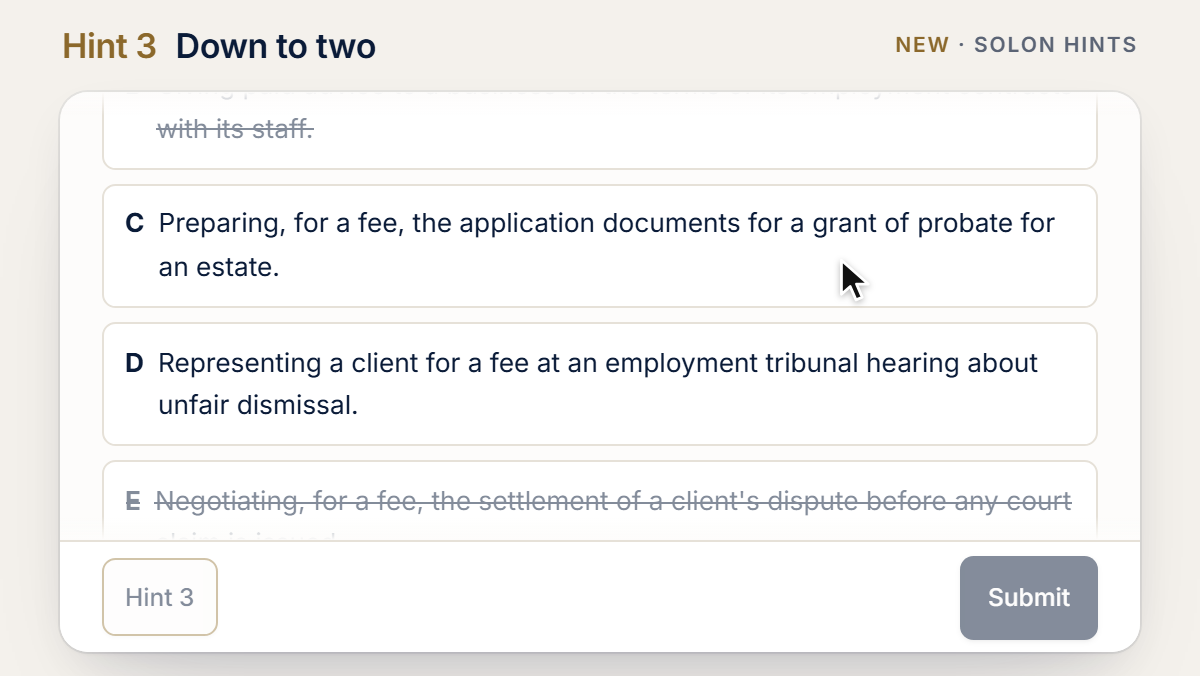
A worked example
This is one of the free questions in the bank. Try it before you read the hints.
The question
A woman runs a business. She is not a solicitor, barrister or chartered legal executive, and she is not authorised or exempt under the Legal Services Act 2007 to carry on any reserved legal activity. She wants to expand the range of services that her business offers to the public, and she asks for advice on which of several proposed services she may lawfully provide. She intends to charge a fee for every service that she provides.
Which proposed service would involve carrying on a reserved legal activity?
- A. Drafting a will for a client in return for a fee, without preparing any probate papers.
- B. Giving paid advice to a business on the terms of its employment contracts with its staff.
- C. Preparing, for a fee, the application documents for a grant of probate for an estate.
- D. Representing a client for a fee at an employment tribunal hearing about unfair dismissal.
- E. Negotiating, for a fee, the settlement of a client's dispute before any court claim is issued.
The three hints
Hint 1: Which of the six reserved legal activities, if any, does each proposed service involve?
Hint 2: The woman is neither authorised nor exempt and charges a fee for every service. For each, what exactly is she doing, and how does that map onto the closed list of reserved activities?
Hint 3 strikes out A, B and E, and says: One option involves preparing papers for a grant of probate, the other advocacy before an employment tribunal. Which of those falls within the reserved list?
The answer
The answer is C. The reserved legal activities are the exercise of rights of audience, the conduct of litigation, reserved instrument activities, probate activities, notarial activities and the administration of oaths. Probate activities include preparing the papers on which an application for a grant of probate is based. Representing a client at an employment tribunal is not on the list, which is why D is the option left beside the answer.
Even at hint 3, you still had to know which of two plausible activities is reserved. That is the same decision the exam asks for.
What happens after you answer
- The verdict says so. A right answer after a hint reads "Correct, with a hint", in gold instead of green.
- The question comes back. It goes into Improve, the part of the bank that brings questions back for review, so you can answer it again later without help.
- Your statistics keep it separate. "Correct with a hint" is counted apart from questions you answered unaided, so your unaided accuracy stays honest.
- It doesn't affect anyone else. A hinted answer is left out of the figures that compare your answer with other candidates'.
The full explanation still appears after every answer, with the reason each wrong option is wrong.
When to use hints, and when not to
Try the question first. Read it, form a view and get properly stuck before you tap. A hint works best when you already know which step you can't do.
Take one hint at a time. After each hint, try to answer. Most of the value is in hints 1 and 2. If you often need hint 3 in a subject, go back to your notes for that subject.
Use them most when a subject is new. In the first weeks on a subject, a hint can keep a practice set moving and stop you guessing. As the exam gets closer, use fewer.
Watch the share of hinted answers fall. If "correct with a hint" is shrinking and unaided correct answers are growing, the hints are doing their job.
Leave them behind for timed work. Timed sets and mock sessions have no hints, the same as the exam. For the format of the papers themselves, see our guide to the SQE1 syllabus and assessment structure.
Where hints are available
- Untimed practice sets, in the Solon view. Press the Hint button in the bottom bar, or H on a keyboard.
- Not in timed work. There are no hints in the exam-style view, timed sets, mock sessions, Improve reviews or the free 10-question test.
- Free accounts included. If you can reach a practice question, you can use its hints.
- Only where a hint set has passed review. The Hint button appears on a question once its three hints have been checked. If we edit a question, its hints are hidden until they have been rewritten for the new version.
Each set of hints is written in advance for one question, from that question's own facts, options and explanation, and checked before it is shown. Nothing is generated on the spot. We describe how the questions themselves are written and checked in how we write SQE1 practice questions.
FAQ
Are there hints in the real SQE1 exam?
No. SQE1 gives you the question and five options, and nothing else. That is why Solon hints are available only in untimed practice. Timed sets and mock sessions in our question bank have no hints, so they stay close to exam conditions.
Does Solon ever tell me the answer?
No. Hint 1 names the issue, hint 2 points at the legal test and the fact that matters, and hint 3 strikes out three wrong options. Two options are always left, and you choose between them.
Does using a hint count against my score?
A right answer after a hint is recorded as "Correct, with a hint" and shown separately in your statistics, so your unaided accuracy is not inflated. The question also goes into Improve and comes back later for you to answer without help.
Are hints available on the free SQE1 practice questions?
Yes. Free accounts can use hints on the free practice questions they can reach. Hints are not available in the free timed mock sessions, because mocks are sat under exam conditions.
Do all practice questions have hints?
The Hint button appears on a practice question once that question's three hints have been written and checked. A question that has been edited hides its hints until they have been rewritten for the new version.
Are the hints generated on the spot?
No. Each set of three hints is written in advance for one question, from that question's own facts, options and explanation, and checked before it is shown. Each tap of the Hint button shows the next hint in that set.
Try a hint on a free question
Our question bank has 5,000+ questions, and 400+ of them are free: 250 practice questions, plus a free timed mock session for FLK1 and for FLK2. Start an untimed practice set, and when a question stops you, tap Hint.
Start with 400+ free questions, or read more about the SQE1 question bank.
This article describes Solon hints as at 11 November 2026. If you spot something out of date, contact us and we'll correct it.