3 free FLK2 sample questions
Original introductory practice questions with worked solutions. These examples are not SRA questions, past papers or extracts from the mock books, and three questions cannot represent the full FLK2 syllabus.
Question 1: Trusts
Ada is the sole registered proprietor and sole beneficial owner of a freehold house in England. She signs a written declaration that she now holds the house on trust absolutely for Ben. The declaration clearly identifies the house and Ben. No transfer of the registered title takes place. Who now holds the legal and beneficial interests?
- Ben holds both interests.
- Ada holds the legal title as trustee; Ben holds the beneficial interest.
- Ada keeps both interests until Ben is registered as proprietor.
- No trust exists because the declaration is not a deed.
- No trust exists because Ben gave no consideration.
Worked solution for question 1
Correct answer: B. The signed written declaration satisfies section 53(1)(b) of the Law of Property Act 1925 for a trust of land. Ada already owns the legal title, so no transfer to another trustee is needed. The trust is completely constituted by her self-declaration.
- A is incorrect: there has been no conveyance of the legal title to Ben. Ada remains the legal owner, now as trustee.
- B is correct: Ada holds the legal title as trustee and Ben has the beneficial interest under the declared trust.
- C is incorrect: registration concerns the legal title; Ben's beneficial interest is created by the valid declaration, not by registering him as proprietor.
- D is incorrect: a deed is not needed for this self-declaration of trust. The signed writing satisfies the statutory requirement.
- E is incorrect: a completely constituted trust is enforceable without consideration from the beneficiary.
Sources: Law of Property Act 1925, section 53.
Question 2: Wills
A testator aged 40 has testamentary capacity and approves the contents of a written will. The testator signs at its end intending to give effect to the will, while two independent adult witnesses are physically present together and watch the signing. Each witness then signs the will in the testator's presence, but they do so separately and neither watches the other sign. Neither witness nor their spouse receives a gift. There is no later marriage, revocation or alteration. Which statement best describes the execution?
- Invalid: each witness must sign in the other witness's presence.
- Invalid: a solicitor must supervise.
- Valid: both witnessed the testator's signature together and each signed in the testator's presence.
- Invalid until registered with a public authority.
- Invalid unless an executor is also a witness.
Worked solution for question 2
Correct answer: C. Section 9 of the Wills Act 1837 requires a written will signed by the testator (or by another person in the testator's presence and at their direction), with the intention of giving effect to it. The signature must be made or acknowledged in the presence of two or more witnesses present at the same time. Each witness must attest and sign, or acknowledge their signature, in the testator's presence; they need not do so in the other witness's presence. Those requirements are met here.
- A is incorrect: both witnesses must be present together for the testator's signing or acknowledgement, but they need not sign in each other's presence.
- B is incorrect: section 9 does not require a solicitor to supervise execution.
- C is correct: both witnesses saw the testator sign while present together, and each then signed in the testator's presence.
- D is incorrect: registration with a public authority is not a requirement for valid execution.
- E is incorrect: there is no requirement for an executor to be a witness.
Sources: Wills Act 1837, section 9.
Question 3: Criminal liability
Leo manages his employer's petty cash. Without permission, he takes £200 from it to pay his own bill. He knows he has no right to the money and that the employer would refuse permission. He intends never to repay it, but believes the missing money will never be discovered. Which statement is correct?
- There can be no theft because Leo lawfully had custody of the cash.
- There can be no theft unless the employer permanently loses the money.
- Leo's belief that he will avoid detection prevents dishonesty.
- Leo commits theft: he dishonestly appropriates money belonging to another with the intention permanently to deprive.
- Theft requires force or a threat of force.
Worked solution for question 3
Correct answer: D. Under section 1 of the Theft Act 1968, theft is the dishonest appropriation of property belonging to another with the intention permanently to deprive the other of it. Taking the employer's money for his own bill assumes an owner's right under section 3. The cash belongs to the employer under section 5. Leo knows he has no right or permission to take it and intends never to repay it: the elements of theft are satisfied.
- A is incorrect: lawful initial custody does not prevent a later dishonest assumption of the owner's rights from being an appropriation.
- B is incorrect: the intention permanently to deprive is key; actual permanent loss is not a prerequisite for theft.
- C is incorrect: a belief that the taking will go undetected does not prevent dishonesty. It does not give Leo a right to the money or permission to take it.
- D is correct: Leo dishonestly appropriates his employer's money with the intention permanently to deprive the employer of it.
- E is incorrect: force or a threat of force is not an element of theft, though force can be relevant to robbery.
Sources: Theft Act 1968, section 1; Theft Act 1968, section 3; Theft Act 1968, section 5.
What's inside
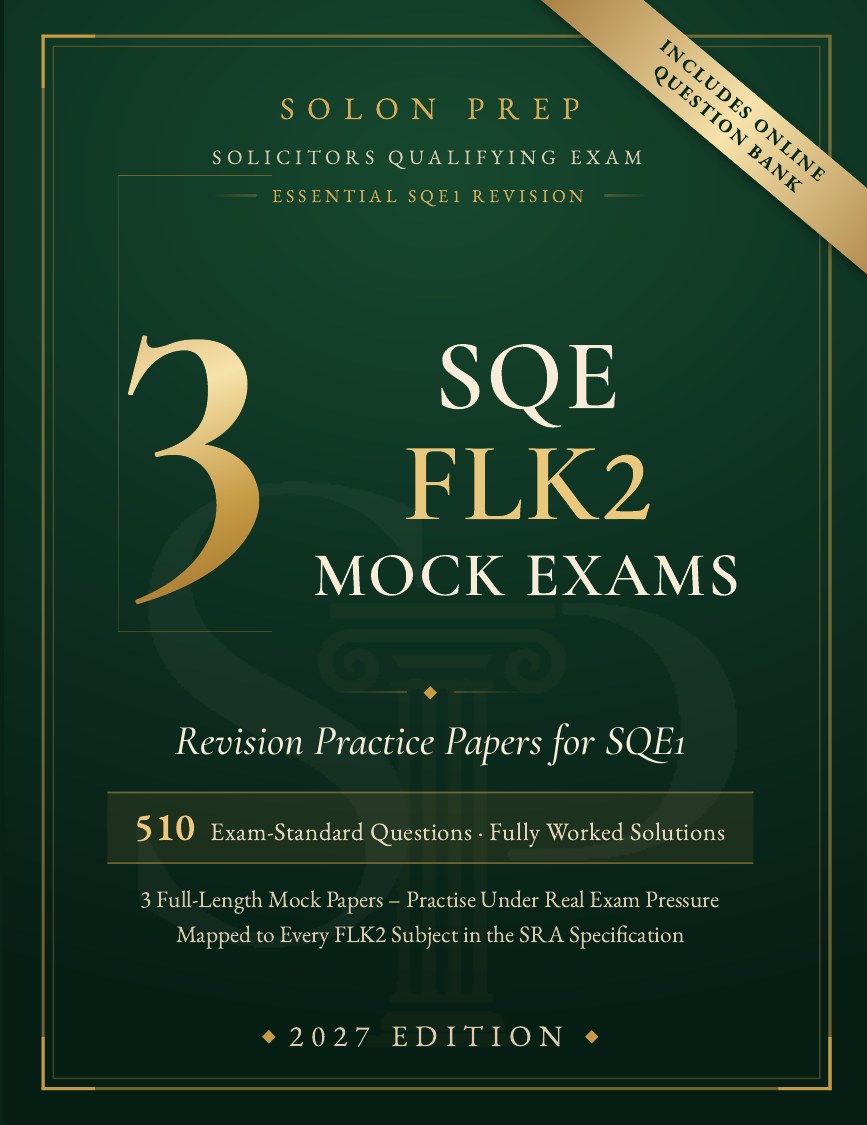
- 3 full FLK2 mock exams
- 170 questions per paper, in two sessions of 85
- Each session limited to the subjects the SRA assigns to it
- 510 single-best-answer questions
- Worked solutions for every question
- Law stated as at 11 September 2026, the January 2027 examinable law cut-off
Source for the exam cut-off: SRA booking windows, checked 30 September 2026.
How each FLK2 paper is built
The SRA's January 2027 groupings for FLK2 (10 September 2026), which every paper in this book follows:
| Session | Questions | Time | Subjects |
|---|---|---|---|
| Session 1 | 85 | 2 hours 33 minutes | Wills and the Administration of Estates; Solicitors Accounts (in the context of wills); Trusts; Land Law |
| Session 2 | 85 | 2 hours 33 minutes | Property Practice; Solicitors Accounts (in the context of property); Criminal Liability; Criminal Law and Practice |
Ethics and professional conduct can be tested in either session.
- Solicitors Accounts appears in both sessions, tested in the context of wills in Session 1 and property in Session 2. Practise the accounts rules in both settings, not just in isolation.
- Property is split across the paper. Land Law sits in Session 1 and Property Practice in Session 2, so a Property Practice question in Session 2 may rely on land law rules that are otherwise tested in Session 1.
Worked solutions for every option
Every question has a worked solution. It explains why the correct answer is right and why each of the other options is wrong, so a near miss shows you exactly which step went wrong.
How to use the three papers
- Sit each session as a single block: 85 questions in 2 hours 33 minutes (about 108 seconds a question), no notes.
- Space the papers out: a baseline first, the second mid-revision, the third in the final weeks before 18 January.
- Review every question, including the ones you got right, and compare session scores: a gap between Session 1 and Session 2 shows which group of subjects needs your time.
Our guide to SQE1 mock exams for January 2027 covers when to sit each mock and how to review it.
Who it's for
- Candidates sitting FLK2 in January 2027 (18 to 22 January), first attempt or resit.
- July 2027 candidates, who should check for changes in the law between 11 September 2026 and the July cut-off of 12 March 2027.
- Candidates who have learned the FLK2 law and now need timed practice across whole sessions.
For FLK1, see SQE1 FLK1 mock exam papers.
Online access
Your book unlocks its own questions in our online question bank at no extra cost. Unlock your book, or try 10 free questions first.
Frequently asked questions
Why does Solicitors Accounts appear in both FLK2 sessions?
The SRA tests it in two contexts from January 2027: wills in Session 1 and property in Session 2. The papers follow that allocation.
Are these SRA past papers?
No. They are Solon Prep practice papers, not SRA past papers or recalled questions.
Is the law up to date for January 2027?
The law is stated as at 11 September 2026, which is the SRA's cut-off date for the January 2027 sitting.
Want to try questions first? See our SQE1 question bank, or read how the SQE1 syllabus is split between FLK1 and FLK2.
Every book unlocks its questions in the online question bank.
Sources
All checked 30 September 2026.
- SRA, Important changes to SQE1 for January 2027 onwards (published 10 September 2026).
- SRA, Booking windows.
- Book contents: book interiors and listing copy.
- Online bank: Solon Prep /unlock.
- 108 seconds: our arithmetic (153 minutes ÷ 85).