FLK1 vs FLK2 at a glance
| Assessment | Core coverage | January 2027 format |
|---|---|---|
| FLK1 | Business Law and Practice; Dispute Resolution; Contract Law; Tort; Legal System (Legal System of England and Wales, Constitutional and Administrative Law and EU Law); Legal Services | 170 questions; two 85-question sessions; 2 hours 33 minutes each |
| FLK2 | Property Law and Practice; Wills and the Administration of Estates; Solicitors Accounts (in the context of Property and Wills); Land Law; Trusts Law; Criminal Liability; Criminal Law and Practice | 170 questions; two 85-question sessions; 2 hours 33 minutes each |
Ethics and professional conduct are tested throughout both assessments, not as a separate paper.
Start with the official specification
The controlling source is the SRA’s SQE1 Assessment Specification, applicable to assessments from 1 September 2026 and marked as updated August 2026 (checked 12 October 2026). This page is a study map, not a replacement for that document. You'll also see it called the SQE specification or the SQE1 syllabus.
The SRA assesses functioning legal knowledge through single-best-answer questions. FLK1 and FLK2 are separate assessments.
FLK1 topics
FLK1 runs 11–15 January 2027: 170 questions in two sessions of 85.
Session 1
FLK2 topics
FLK2 runs 18–22 January 2027: 170 questions in two sessions of 85.
Session 1
- Wills and the Administration of Estates14–20% of FLK2 (band includes Solicitors Accounts in the wills context) · 19 lines
- Solicitors Accounts (in the context of Wills)Counted within the Wills and Administration of Estates band (Annex 4) · 13 lines
- Trusts Law14–20% of FLK2 · 19 lines
- Land Law14–20% of FLK2 · 19 lines
Session 2
- Property Law and Practice14–20% of FLK2 (band includes Solicitors Accounts in conveyancing) · 24 lines
- Solicitors Accounts (in the context of Property)Counted within the Property Practice band (Annex 4) · covered with Property
- Criminal Liability14–20% of FLK2 · 13 lines
- Criminal Law and Practice14–20% of FLK2 · 22 lines
Try 3 free introductory FLK2 questions with worked solutions.
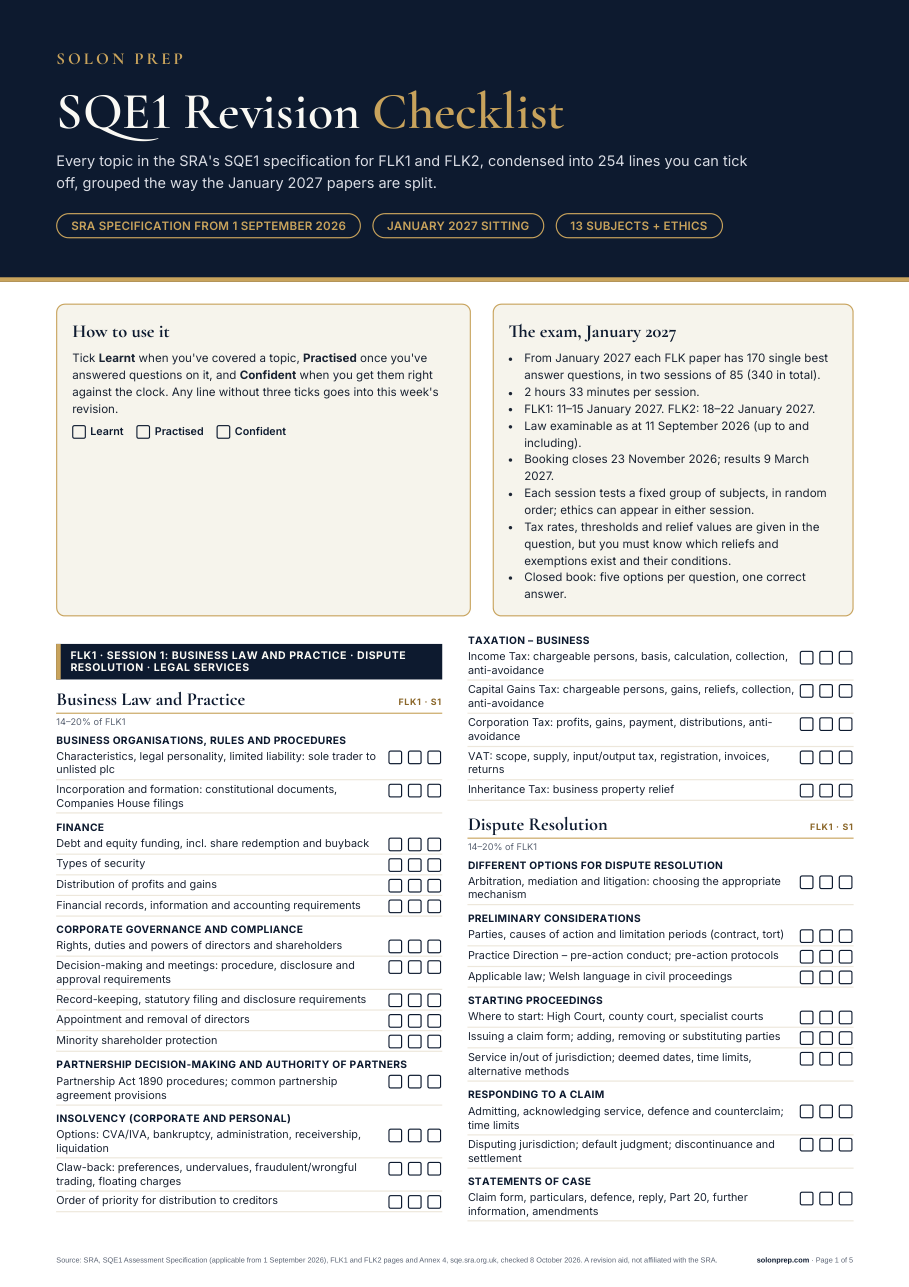
Get the printable checklist
The same 254 lines as a two-column PDF with tick boxes, emailed to you now.
Assessment format by sitting
Up to and including July 2026
180 questions per FLK
Each FLK paper was split into two sessions of 90 questions. Each session lasted 2 hours 33 minutes. July 2026 was the last sitting with 180 questions per paper.
From January 2027
170 questions per FLK
Each FLK paper is split into two sessions of 85 questions, with 2 hours 33 minutes per session. Subjects are allocated to fixed session groups, while questions remain randomised within a session.
Read the SRA announcement, published 10 September 2026 or Solon Prep’s January 2027 format guide.
The January 2027 sitting examines the law in force on 11 September 2026 (SRA booking windows, checked 12 October 2026).
September 2026 specification changes
The updated FLK specification applies from 1 September 2026. Tax rates, relief values and thresholds needed for a question are now supplied in it; “the appeal system” was removed from FLK1 Legal System, and criminal legal aid was removed from Legal Services. Sources: SRA assessment specification (updated August 2026, checked 12 October 2026) and SRA changes summary (checked 12 October 2026).
SQE syllabus: the 13 FLK1 and FLK2 subject areas
The following 13 areas reproduce the SRA’s high-level categories. Consult the official assessment-topics overview and specification for the detailed scope.
FLK1 · six areas
- 1Business Law and Practice
- 2Dispute Resolution
- 3Contract Law
- 4Tort
- 5Legal System (Legal System of England and Wales, Constitutional and Administrative Law and EU Law)
- 6Legal Services
FLK2 · seven areas
- 1Property Law and Practice
- 2Wills and the Administration of Estates
- 3Solicitors Accounts (in the context of Property and Wills)
- 4Land Law
- 5Trusts Law
- 6Criminal Liability
- 7Criminal Law and Practice
Full SQE1 specification checklist
Tick Learnt when you've covered a topic, Practised once you've answered questions on it, and Confident when you get them right against the clock.
The three empty boxes on each line are L for Learnt, P for Practised and C for Confident.
FLK1 (11–15 January 2027)
Session 1
Business Law and Practice
14–20% of FLK1 · 20 lines
Business organisations, rules and procedures
- Characteristics, legal personality, limited liability: sole trader to unlisted plc
- Incorporation and formation: constitutional documents, Companies House filings
Finance
- Debt and equity funding, incl. share redemption and buyback
- Types of security
- Distribution of profits and gains
- Financial records, information and accounting requirements
Corporate governance and compliance
- Rights, duties and powers of directors and shareholders
- Decision-making and meetings: procedure, disclosure and approval requirements
- Record-keeping, statutory filing and disclosure requirements
- Appointment and removal of directors
- Minority shareholder protection
Partnership decision-making and authority of partners
- Partnership Act 1890 procedures; common partnership agreement provisions
Insolvency (corporate and personal)
- Options: CVA/IVA, bankruptcy, administration, receivership, liquidation
- Claw-back: preferences, undervalues, fraudulent/wrongful trading, floating charges
- Order of priority for distribution to creditors
Taxation – business
- Income Tax: chargeable persons, basis, calculation, collection, anti-avoidance
- Capital Gains Tax: chargeable persons, gains, reliefs, collection, anti-avoidance
- Corporation Tax: profits, gains, payment, distributions, anti-avoidance
- VAT: scope, supply, input/output tax, registration, invoices, returns
- Inheritance Tax: business property relief
Dispute Resolution
14–20% of FLK1 · 21 lines
Different options for dispute resolution
- Arbitration, mediation and litigation: choosing the appropriate mechanism
Preliminary considerations
- Parties, causes of action and limitation periods (contract, tort)
- Practice Direction – pre-action conduct; pre-action protocols
- Applicable law; Welsh language in civil proceedings
Starting proceedings
- Where to start: High Court, county court, specialist courts
- Issuing a claim form; adding, removing or substituting parties
- Service in/out of jurisdiction; deemed dates, time limits, alternative methods
Responding to a claim
- Admitting, acknowledging service, defence and counterclaim; time limits
- Disputing jurisdiction; default judgment; discontinuance and settlement
Statements of case
- Claim form, particulars, defence, reply, Part 20, further information, amendments
Interim applications
- Application procedure: summary judgment, interim payments, interim injunctions
Case management
- Overriding objective, track allocation and case management directions
- Sanctions and relief; costs and case management conferences
Evidence, disclosure and inspection
- Evidence: relevance, hearsay, admissibility, burden, standard
- Experts (incl. single joint), witness statements, affidavits
- Disclosure (standard, specific, pre-action, non-party, electronic); inspection
- Privilege, without prejudice, waiver
Trial
- Trial: summoning witnesses, checklists, bundles, procedure, etiquette, judgment
Costs
- Costs: budgeting, costs orders, non-party, Part 36/other offers, security, fixed/assessed
Appeals and enforcement
- Appeals: permission, destination and grounds
- Enforcement: obtaining information from judgment debtor; enforcement methods
Legal Services
12–16% of FLK1 · 17 lines
The regulatory role of the SRA
- Principles and risk-based regulation
- Reserved legal activities
- Professional indemnity insurance
- Other regulated providers of legal services
- Overriding legal obligations: the Equality Act 2010
Money laundering
- Purpose and scope of AML legislation, incl. international context
- When suspicion of money laundering should be reported
- To whom, when and how suspicions are reported
- POCA 2002 direct/non-direct involvement offences and defences
- Due diligence requirements
Financial services
- Regulatory framework and authorisation as applied to solicitors' firms
- Specified investments, specified activities and relevant exemptions
- FSMA 2000 and secondary legislation in solicitors' work
Funding options for legal services
- Private retainer and fixed fees
- Conditional fee agreements and damages based agreements
- Eligibility for civil legal aid
- Third party funding and legal expenses insurance
Session 2
Tort
14–20% of FLK1 · 16 lines
Negligence
- Duty of care, standard (general and professional) and breach
- Causation (single and multiple)
- Remoteness and loss
- Remedies for personal injury and death claims
- Pure economic loss: negligent acts and misstatements
- Psychiatric harm
- Employers' primary liability (common law)
Defences
- Volenti non fit injuria, contributory negligence, illegality
Vicarious liability
- Principles of vicarious liability
Occupiers' liability
- OLA 1957 (visitors) and OLA 1984 (non-visitors)
- Occupiers' liability: defences and exclusion of liability
Product liability
- Product liability in negligence
- Consumer Protection Act 1987
Nuisance
- Public and private nuisance
- The rule in Rylands v Fletcher
- Nuisance remedies (damages, injunctions) and defences
Contract Law
14–20% of FLK1 · 20 lines
Formation
- Offer and acceptance
- Consideration
- Intention to create legal relations, certainty, capacity
Parties
- Privity of contract and rights of third parties
Contract terms
- Express terms and incorporation of terms
- Terms implied by common law and statute
- Exemption clauses
- Interpretation of contract terms; variation
- Classification: conditions, warranties, innominate terms
Vitiating factors
- Misrepresentation
- Mistake
- Unfair contract terms
- Duress, undue influence and illegality
Termination
- Expiry or other specified event; breach
- Frustration
- Restitution and unjust enrichment on termination
Remedies
- Damages; liquidated sums and penalties; duty to mitigate
- Specific performance and injunctions
- Indemnities and guarantees
Causation and remoteness
- Causation and remoteness
Legal System
14–20% of FLK1 · 20 lines
Legal System of England and Wales and sources of law
- Courts: judicial function, hierarchy, jurisdiction, rights of audience
- The doctrine of precedent
- Structure of Acts of Parliament and Acts of Senedd Cymru
- Literal, golden and mischief rules; purposive approach
- Presumptions and aids to interpretation; interpreting Senedd legislation
- Applying Senedd and Westminster legislation to England, Wales
Constitutional and Administrative Law
- Parliament and parliamentary sovereignty
- Central government and accountability
- Devolved institutions and their relationship with Westminster
- The monarch, the Crown and constitutional conventions
- Prerogative power: relationship with legislation and conventions
- Parliamentary privilege
- Enacting, implementing, repealing legislation: Westminster, Senedd, Welsh Ministers
- Separation of powers and the rule of law
- Public order: processions, assemblies, breach of the peace
Judicial review
- Nature, process, limits, supervisory nature and remedies
- Decisions challengeable, standing and time limits
- Grounds: illegality, irrationality, procedural impropriety, legitimate expectation
Human rights and EU law
- HRA 1998 ss.2–4, 6–8, 10 and Sch 1 Convention Rights
- The place of EU law in the UK constitution
FLK2 (18–22 January 2027)
Session 1
Wills and the Administration of Estates
14–20% of FLK2 (band includes Solicitors Accounts in the wills context) · 19 lines
Wills and intestacy
- Validity: testamentary capacity, knowledge and approval
- Validity: duress, undue influence, formalities, burden of proof
- Executors and PRs: eligibility, suitability, renunciation, reservation of power
- Alterations before/after execution; use and effect of codicils
- Revocation methods; effect of divorce or dissolution
- Interpretation: types of gift and failure of gifts
- Intestacy: AEA 1925 s.46 and the statutory trusts
- Property outside the estate: joint property, policies, pensions, trusts
Probate and administration practice
- Need for a grant; Non-Contentious Probate Rules order of priority
- Grants: probate, letters of administration (with or without will)
- Valuation, excepted estates, funding the initial Inheritance Tax
- Burden, liability and incidence of Inheritance Tax
- PRs' duties before distribution: collect, preserve, pay, account
- PR liability and protection: unknown/missing/insolvent beneficiaries, creditors
- Selling assets to pay expenses, tax, debts, legacies; distribution
- 1975 Act claims: time limit, applicants, grounds and factors
Taxation – wills and administration
- IHT lifetime transfers: chargeable, potentially exempt, reservation of benefit
- IHT on death; exemptions, reliefs and anti-avoidance
- PRs' Income Tax and CGT; beneficiaries' CGT on inherited assets
Solicitors Accounts (in the context of Wills)
Counted within the Wills and Administration of Estates band (Annex 4) · 13 lines
Client money and client account
- Client money: definition, paying in, withholding, repayment
- Client account: meaning, name, no banking facilities, withdrawals
- Keeping client money separate from the authorised body's money
- Interest on client money
Breaches
- Duty to correct breaches promptly on discovery
Records and accounting entries
- Client ledgers, accurate records and client account reconciliation
- Disbursements: agency and principal methods
- Transfers between ledgers
- Bills: submission, reduction and payment, incl. VAT element
- Double-entry accounting entries for each transaction type
Other accounts and reporting
- Joint accounts and operating a client's own account
- Third-party managed accounts
- Accountants' reports; storage and retention of accounting records
Trusts Law
14–20% of FLK2 · 19 lines
Creation and requirements of express trusts
- Three certainties in fixed interest and discretionary trusts
- Formalities to create express inter vivos trusts
- Constitution; equity will not assist a volunteer
- Exceptions: Re Rose, Strong v Bird, Choithram v Pagarani
Beneficial entitlement
- Fixed, discretionary, vested and contingent interests
- The rule in Saunders v Vautier
Purpose trusts
- Charitable trusts vs non-charitable purpose trusts
Resulting trusts
- Automatic and presumed resulting trusts
Trusts of the family home
- Common intention constructive trust: title, declarations, contributions
- Requirements to establish proprietary estoppel
Liability of strangers to the trust
- Knowing receipt and dishonest assistance
The fiduciary relationship
- Fiduciary duties: no profit, no purchase, no conflict
Trustees
- Who can be a trustee; appointment, removal, retirement
- Trustees' duty of care
- Duty to invest and investment powers
- Statutory powers of maintenance and advancement
Trustees' liability
- Breach of trust and measure of liability
- Protection of trustees and limitation period
Equitable remedies
- Nature of equitable remedies; tracing in equity
Land Law
14–20% of FLK2 · 19 lines
Nature of land
- Real property vs personal property
- Acquiring and transferring legal estates
- Acquiring and disposing of legal and equitable interests
- Protecting and enforcing third party interests
- Different ways in which land can be held
- Formalities to create and transfer estates and interests
Title to land
- Registered land: substantively registrable estates; protecting interests
- Overriding interests vs interests protected on the register
- Unregistered land: title deeds, Land Charges, doctrine of notice
Co-ownership and trusts
- Joint tenants vs tenants in common, in law and equity
- Survivorship and severance of joint tenancies
- Co-owner disputes: TOLATA 1996 ss.14 and 15
Proprietary rights
- Easements: essential characteristics and methods of creation
- Freehold covenants: passing of benefit and burden
- Mortgages: terms, priority, lender's powers/duties, third parties
Leases
- Landlord–tenant relationship; lease vs licence
- Privity of contract/estate; passing of leasehold covenants
- Alienation covenants: purpose and effect
- Remedies for breach incl. forfeiture; ending a lease
Session 2
Property Law and Practice
14–20% of FLK2 (band includes Solicitors Accounts in conveyancing) · 24 lines
Freehold transactions
- Key elements of freehold transactions; Law Society Conveyancing Protocol
- Title: official copies, epitome, issues arising, reporting to client
- Pre-contract searches and enquiries: range, purpose, who, results
- Finance and acting for lender: requirements, certificate of title
- Sale contract: SCS, SCPC, special conditions, deposit, insurance, VAT
- Exchange: formulae, authority, timing, consequences
- Pre-completion: transfer deed, execution, searches, apportionments
- Completion methods and effect; post-completion steps
- Delayed completion: damages, compensation, notice to complete, rescission
Leasehold transactions
- Lease clauses: repair, insurance, alterations, user, rent review
- Alienation, break clauses; Code for Leasing Business Premises
- Grant of lease/underlease: drafting, agreement for lease, title, completion
- Assignment: contract, landlord's consent, deed, AGA, completion
- Licence to assign/underlet: who drafts, privity, key provisions
- Leasehold covenants: leases granted before vs from 1 January 1996
- Breach remedies: debt, forfeiture, CRAR, guarantor/rent deposit, damages
- Specific performance and self-help remedies
- Lease termination: effluxion of time, surrender, merger
- LTA 1954 Pt II: contracting out, renewal, new lease terms
- LTA 1954: termination, grounds of opposition, compensation
Planning law
- Planning: development, no-permission matters, building regulations, enforcement
Taxation – property
- SDLT (England) and LTT (Wales): residential and non-residential
- VAT: standard, exempt, zero-rated supplies; option to tax
- CGT: basis of charge and Private Residence Relief
Solicitors Accounts (in the context of Property)
Counted within the Property Practice band (Annex 4) · covered with Property
Criminal Liability
14–20% of FLK2 · 13 lines
Specified offences
- Assault and battery; OAPA 1861 ss.47, 20, 18
- Theft Act 1968 ss.1, 8, 9, 10
- Criminal damage: simple, aggravated, arson
- Murder
- Voluntary manslaughter
- Involuntary manslaughter: unlawful act, gross negligence
- Fraud: false representation, abuse of position, failing to disclose
Definition of the offence
- Actus reus
- Mens rea
Defences
- General defences: intoxication; self-defence/defence of another
- Partial defences: loss of control; diminished responsibility
Parties and inchoate offences
- Principal offenders and accomplices
- Attempt to commit an offence
Criminal Law and Practice
14–20% of FLK2 · 22 lines
Police station (incl. vulnerable clients)
- Rights: legal advice, informing someone, detention reviews/limits (Code C)
- Identification procedures: when held, types, PACE Code D
- Right to silence and adverse inferences
- Interview: solicitor's role, appropriate adult, lawful interview (Code C)
Bail and first hearings
- Bail: right, exceptions, conditions, applications, appeals, breaches
- First hearing: classification, representation order, defence solicitor's role
- Plea before venue, allocation, sending (MCA 1980, CDA 1998)
- Case management, PTPH and disclosure (incl. unused material)
Admitting and excluding evidence
- Visual identification evidence and Turnbull guidelines
- Inferences from silence: CJPOA 1994 ss.34–38
- Hearsay and confession evidence: admissibility and challenges (s.76 PACE)
- Bad character: definition, gateways (CJA 2003 ss.100, 101), exclusion
- s.78 PACE exclusion and the right to a fair trial
Trial procedure
- Burden and standard of proof; trial stages; no case
- Etiquette, leading questions, competence, compellability, special measures
- Defendant's good character; solicitor's duty to the court
Sentencing
- Guidelines, seriousness, aggravation, mitigation, concurrent/consecutive sentences
- Custodial and suspended sentences, community orders; Newton hearings
Appeals
- Appeals from magistrates' court (incl. case stated) and Crown Court
Youth court
- Youth court: jurisdiction, grave crimes, youths jointly charged
- Youth sentencing guidelines (incl. Robbery); DTOs, YROs, referral orders
Welsh language
- Welsh language in criminal proceedings
Ethics and Professional Conduct
Pervasive in every subject and session; with money laundering, up to 20% of questions in any sitting (Annex 4) (money laundering in FLK1 only) · 11 lines
SRA Standards and Regulations
- Purpose, scope and content of the SRA Principles
- SRA Code of Conduct for Solicitors, RELs, RFLs, RSLs
- Obligations of managers in authorised firms
- Obligations of compliance officers
Statement of Solicitor Competence A1 (Annex 1)
- Recognising ethical issues and exercising effective judgment
- Understanding and applying ethical concepts governing a lawyer's role
- Identifying and following relevant SRA principles and conduct rules
- Resisting pressure to condone, ignore or commit unethical behaviour
- Respecting diversity and acting fairly and inclusively
How it is examined
- Ethical problems set in any subject, in both sessions
- Scenarios from SRA warning notices, e.g. NDAs and SLAPPs
Prefer it on paper?
Pervasive ethics
Ethics and professional conduct can be tested across both FLK1 and FLK2. They should be integrated into subject practice rather than treated as a separate topic to leave until the end.
A scenario may require both legal analysis and recognition of the professional obligations that shape the best response.
Official categories and Solon Prep chapter groupings
The official SRA list above contains six FLK1 areas and seven FLK2 areas. Solon Prep’s Essential SQE1 Questions uses a product-specific chapter structure for its 500 questions. Those chapter labels and question counts are editorial groupings, not an official SRA allocation or blueprint.
Use the 400+ free questions to connect subject areas to applied SBA practice.
SQE1 specification FAQs
What is in the SQE1 specification?
Two functioning legal knowledge assessments. FLK1 covers Business Law and Practice, Dispute Resolution, Contract Law, Tort, Legal System and Legal Services. FLK2 covers Property Law and Practice, Wills and the Administration of Estates, Solicitors Accounts, Land Law, Trusts Law, Criminal Liability and Criminal Law and Practice. Ethics and professional conduct are tested across both.
Is the SQE syllabus the same as the SQE specification?
Yes. "SQE syllabus" is the informal name for the SRA's SQE1 Assessment Specification, which sets out everything FLK1 and FLK2 can test. This page follows the version applicable from 1 September 2026, updated August 2026.
What topics are in FLK1?
Session 1 tests Business Law and Practice, Dispute Resolution and Legal Services. Session 2 tests Tort, Contract Law and Legal System. The checklist above breaks these into 114 lines.
What topics are in FLK2?
Session 1 tests Wills and the Administration of Estates (with Solicitors Accounts), Trusts Law and Land Law. Session 2 tests Property Law and Practice (with Solicitors Accounts), Criminal Liability and Criminal Law and Practice. The checklist above breaks these into 129 lines.
How many questions are in SQE1 from January 2027?
Each FLK paper has 170 single best answer questions in two sessions of 85, so 340 in total. Each session lasts 2 hours 33 minutes.
When is the January 2027 SQE1, and what law is tested?
FLK1 runs 11–15 January 2027 and FLK2 18–22 January 2027. The law examinable is the law in force on 11 September 2026. Booking closes 23 November 2026.
Do I need to memorise tax rates for SQE1?
No. From September 2026 the rates, thresholds and relief values you need are given in the question, but you still need to know which reliefs and exemptions exist and when they apply.
Is ethics a separate SQE1 paper?
No. Ethics and professional conduct can appear in any subject and either session. With money laundering, it can make up to 20% of the questions in a sitting.